
Περιγραφή
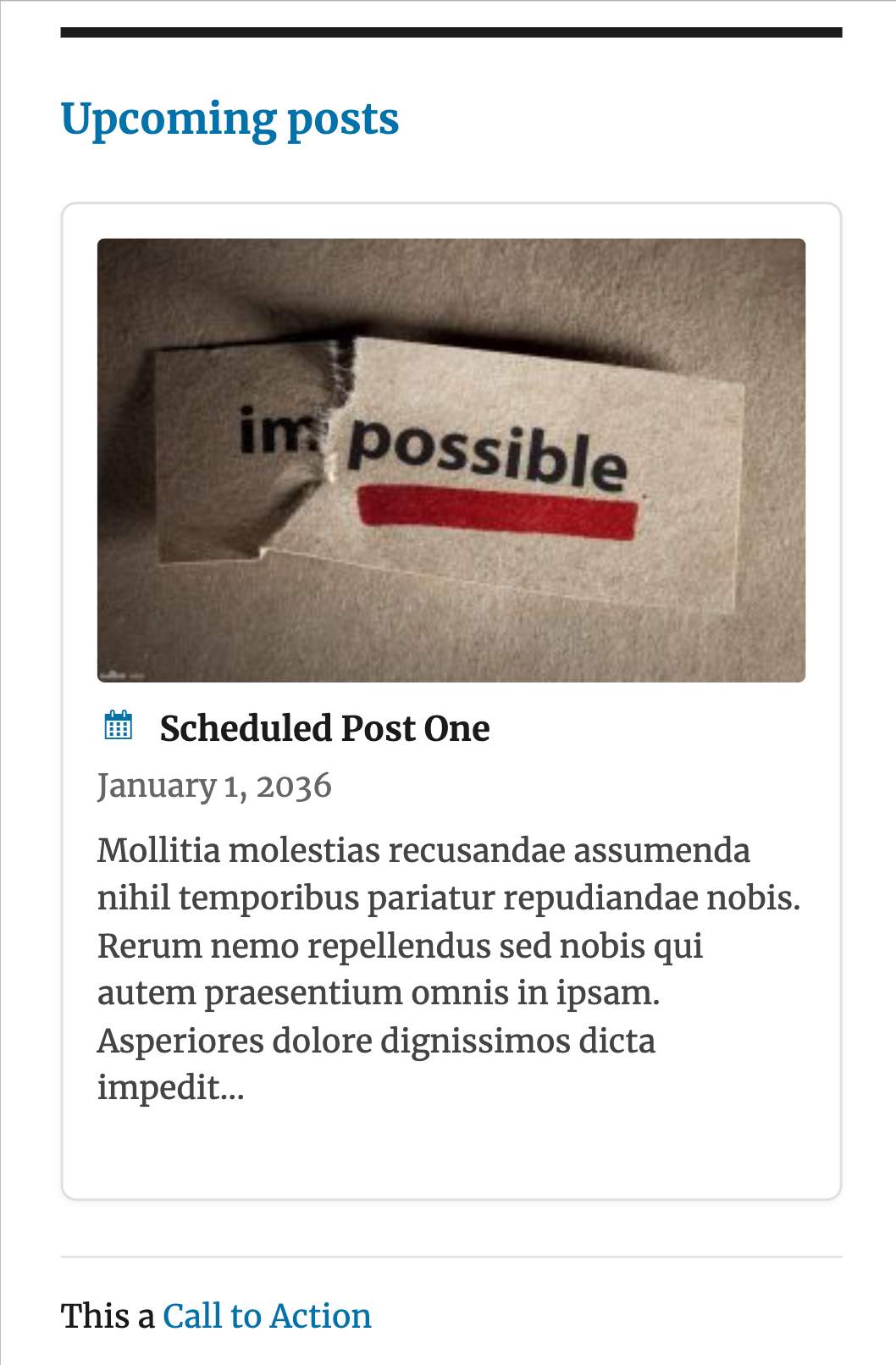
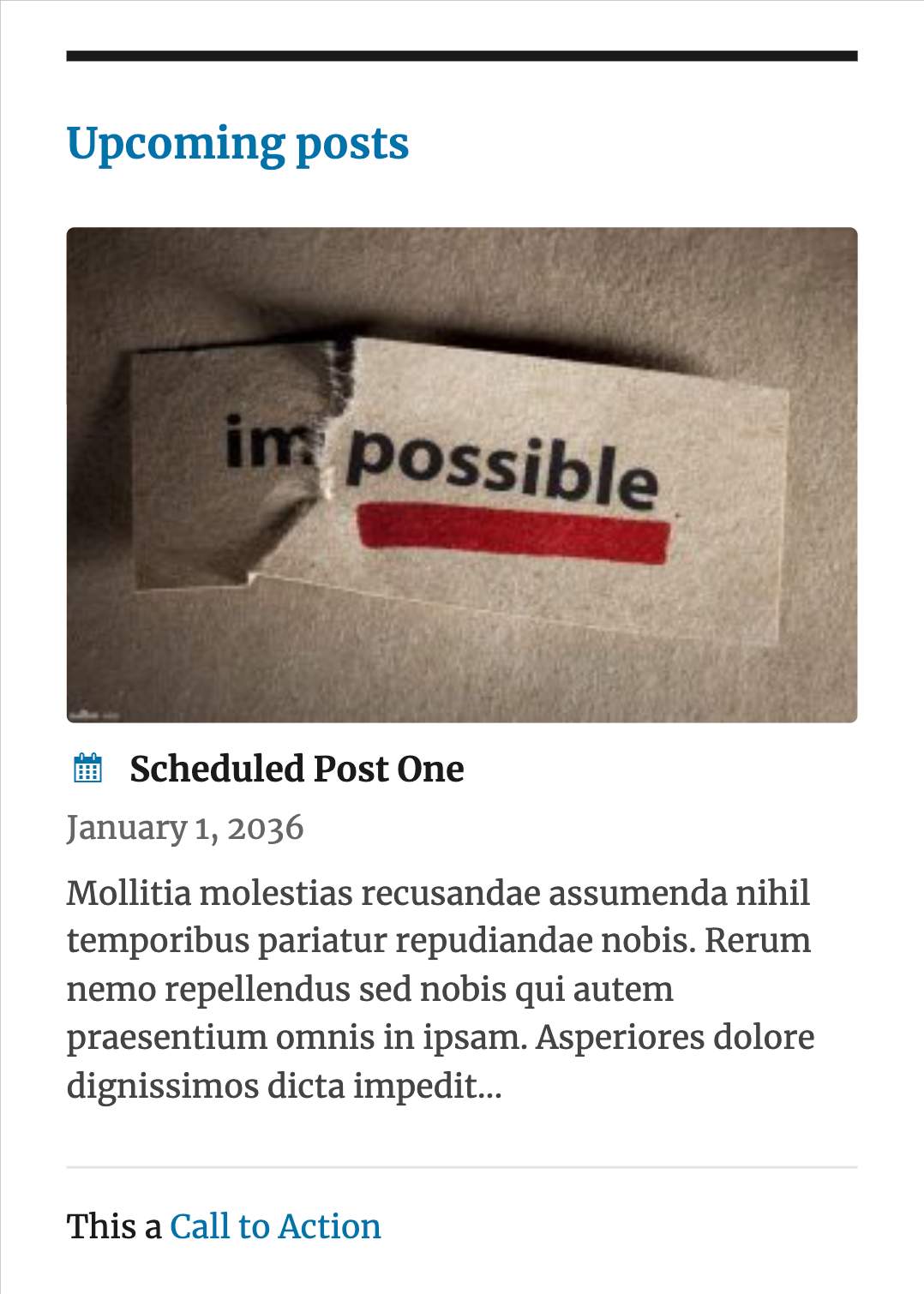
Scheduled Posts Showcase lets you display your scheduled (future) posts on the frontend of your WordPress site without creating problematic links to unpublished content.
Unlike other solutions that link to scheduled posts and generate 404 errors for visitors, this plugin shows post information (title, date, excerpt, featured image, categories) without ever exposing the permalink or post ID.
Key Features
- No 404 errors – Never generates links to unpublished content
- Multiple display methods – Use shortcode, widget, Gutenberg block, or REST API
- Content filters – Pick what to list by taxonomy, author and post type
- Fully customizable – Control what information to display and how it looks
- Global settings with per-instance overrides – Set defaults once, customize where needed
- Translation ready – Fully prepared for localization
- Developer friendly – Extensive hooks for customization
Content Filters
Choose exactly which scheduled posts get listed:
- Post types – One or several at a time, so posts, events and any other public post type can share the same list, plus an “All content types” box that also covers the ones registered later
- Taxonomies – Categories, tags and any other public taxonomy, including the ones registered by your custom post types
- Include or exclude – Show only the posts in the ticked terms, or hide them
- Authors – Perfect for a “coming soon” section per columnist on multi-author sites
Every filter starts on “any”, so nothing is filtered until you untick one and pick what you want. Filters can be set globally in the settings page and overridden on each widget, block and shortcode.
Display Options
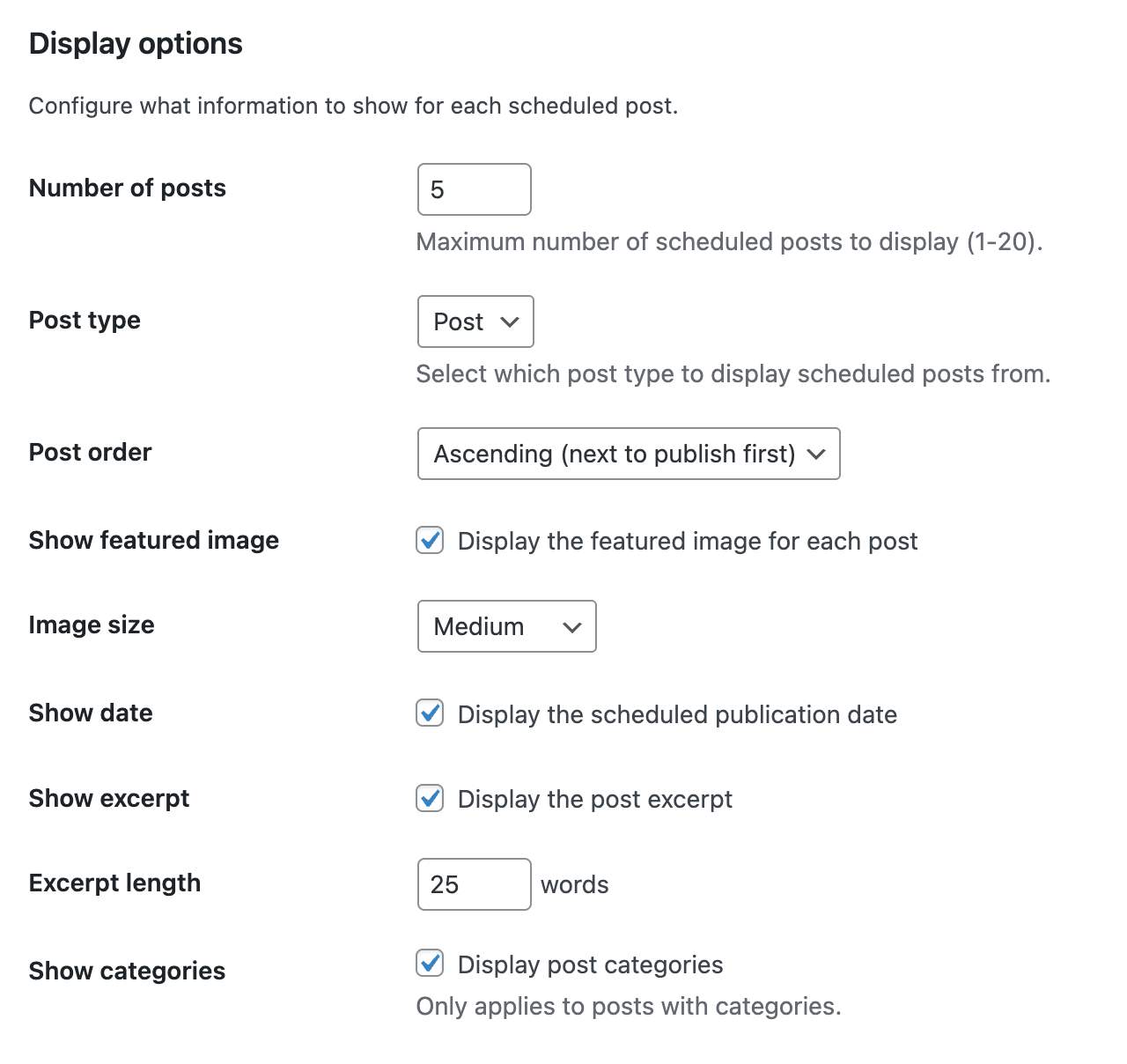
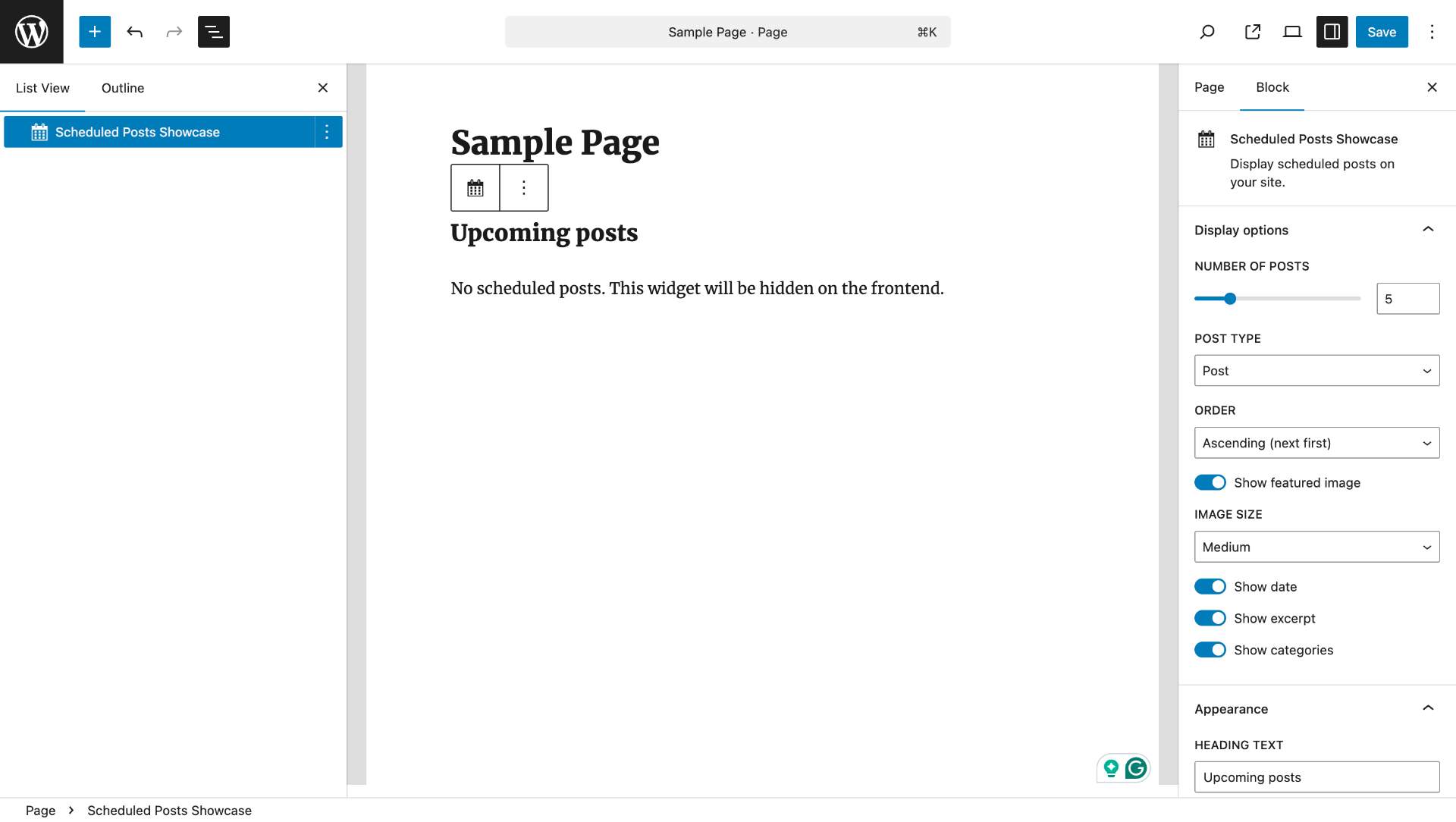
- Number of posts to show
- Featured image at any registered size, including a responsive “full width” option that fills the container
- Scheduled publication date
- Post excerpt (with configurable word count)
- Categories
- Custom heading with selectable HTML tag (headings, paragraph, span or div)
- Custom footer content for calls to action
- Custom CSS classes on the main container, both globally and per instance
Appearance Options
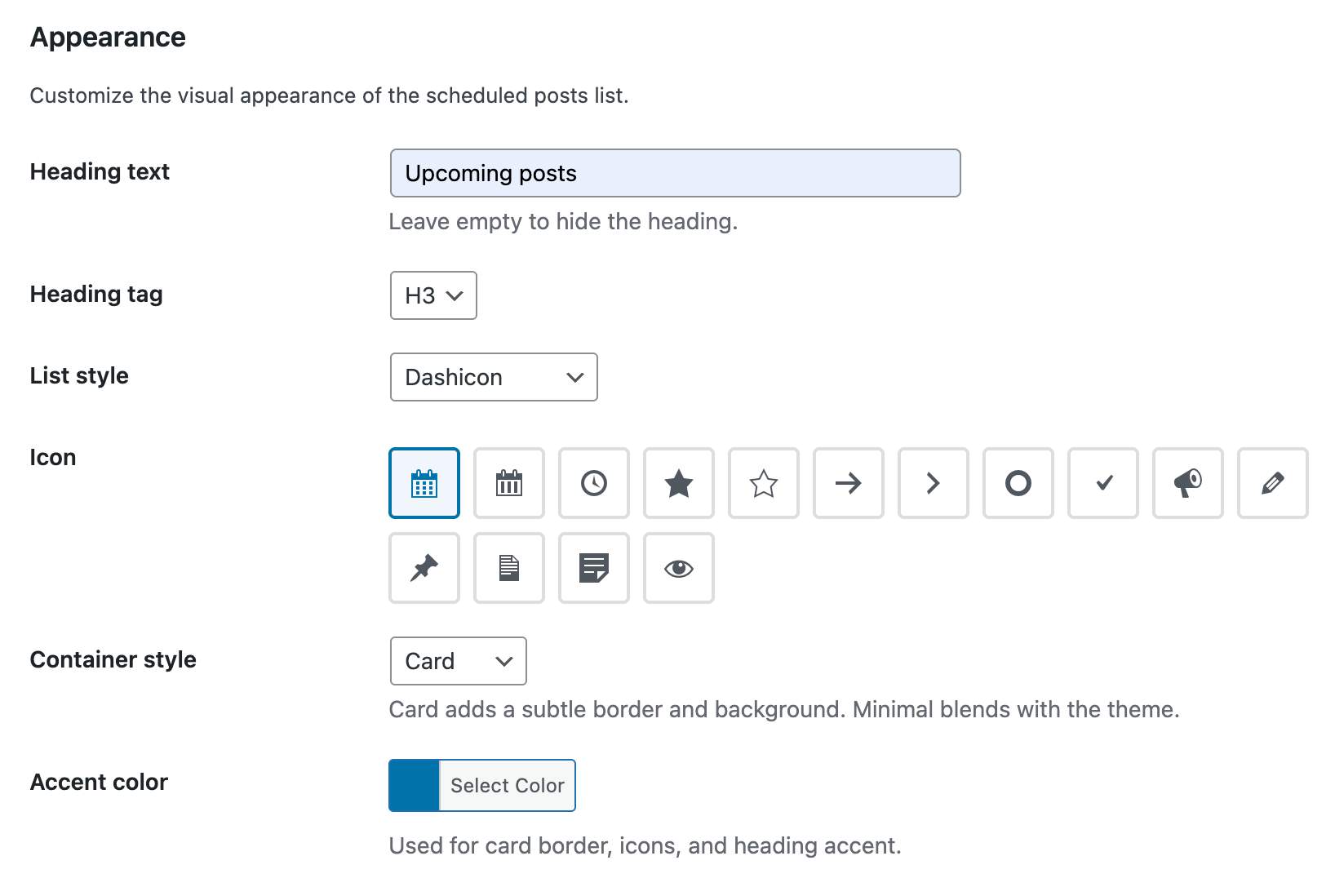
- Card or minimal container style
- Dashicon, theme default, or no list bullets
- Curated icon selector for list bullets
- Accent color customization
- Responsive design
Visibility Control
Choose who can see your scheduled posts:
- Everyone (public)
- Logged-in users only
- Editors and administrators only
Usage
Shortcode:
[scheduled-posts-showcase]
Without parameters it uses everything configured in Appearance Scheduled Posts. With parameters:
[scheduled-posts-showcase count="3" show_date="1" show_excerpt="1" container_style="card"]
Filtering by content:
[scheduled-posts-showcase post_type="post,event" categories="news,tutorials" authors="fernando" tax_mode="include"]
post_type– one slug, a comma-separated list, orallfor every public post typecategoriesandtags– term IDs or slugs, comma-separated, orallto skip that filtertax_<taxonomy>– any other taxonomy, for exampletax_genre="fiction,essay"authors– user IDs or nicenames, comma-separated, orallto skip that filtertax_mode–include(default) orexclude
Attributes you do not write inherit the global settings, so [scheduled-posts-showcase categories="news"] keeps everything else as configured.
Widget:
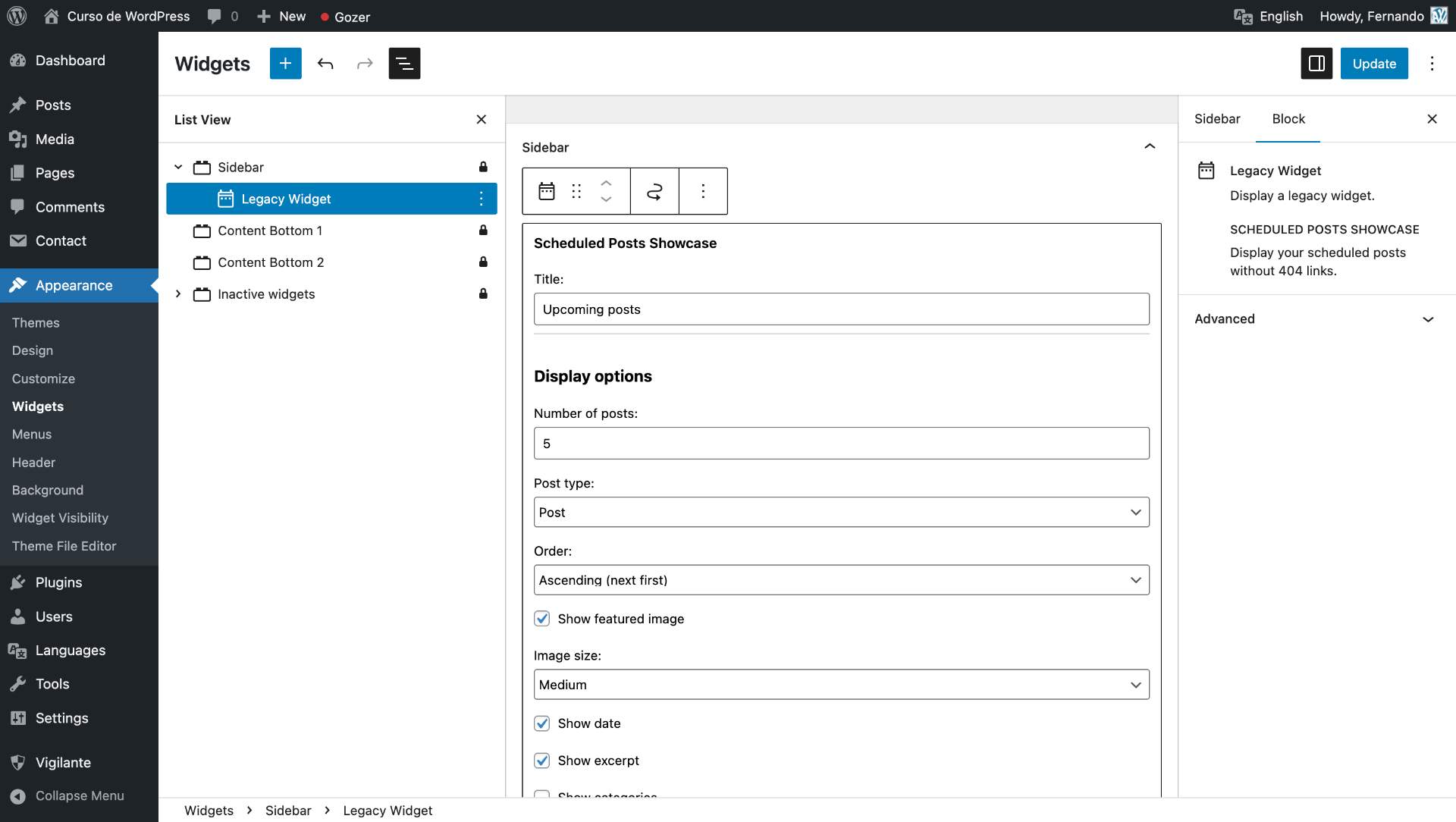
Add the “Scheduled Posts Showcase” widget to any widget area from Appearance Widgets.
Gutenberg Block:
Search for “Scheduled Posts” in the block inserter and add the block to any post or page.
REST API:
GET /wp-json/scheduled-posts-showcase/v1/scheduled-posts
Parameters: per_page, fields, post_type (comma-separated or all), order, categories, tags, taxonomy, terms, authors, tax_mode. Term and author parameters also accept all to skip that filter.
GET /wp-json/scheduled-posts-showcase/v1/scheduled-posts?post_type=post,event&categories=news&authors=12
Why This Plugin?
Existing plugins for displaying scheduled posts either:
- Are abandoned (some over 10 years old)
- Link to scheduled posts, causing 404 errors
- Use deprecated WordPress functions
- Lack modern features like Gutenberg blocks
Scheduled Posts Showcase solves all these problems with a modern, secure, and fully-featured solution.
CSS Customization
The plugin provides semantic CSS classes for easy customization.
Available CSS Classes
.sps-scheduled-posts– Main container.sps-style-card– Card style container.sps-style-minimal– Minimal style container.sps-scheduled-heading– Heading element.sps-scheduled-list– Posts list (ul).sps-list-dashicon– List with dashicon bullets.sps-list-theme– List with theme default bullets.sps-list-none– List with no bullets.sps-scheduled-item– Each post item (li).sps-scheduled-icon– Dashicon bullet.sps-scheduled-thumbnail– Featured image container.sps-scheduled-thumbnail--full-width– Added to the thumbnail container when the “Full width” image size is selected.sps-scheduled-title– Post title.sps-scheduled-date– Scheduled date.sps-scheduled-excerpt– Post excerpt.sps-scheduled-categories– Categories list.sps-scheduled-footer– Custom footer content.sps-no-scheduled– Empty state message
Example Customizations
/* Change font size for post titles */
.sps-scheduled-title {
    font-size: 1.1em;
}

/* Add more padding to the card container */
.sps-style-card {
    padding: 1.5em;
}

/* Custom color for the date */
.sps-scheduled-date {
    color: #666;
    font-style: italic;
}
Custom CSS Classes
You can target a specific widget, block or shortcode without writing a long selector by adding your own classes:
- Global: Appearance Scheduled Posts Appearance section “Custom CSS class”. Space-separated. Applied to every instance.
-
Per instance: each widget, block and shortcode has its own “Extra CSS class” field. These are appended to the global ones, never replace them.
/* Style a specific instance */
.sps-scheduled-posts.sidebar-cta {
background: #fffbe6;
padding: 1.5em;
}
CSS Custom Property
The accent color is available as a CSS custom property:
/* Use the accent color in your custom styles */
.my-custom-element {
    border-color: var(--sps-accent-color);
}<h3>Developer Hooks</h3>
The plugin provides filters and actions for developers to customize behavior without modifying plugin code.
Filters with Examples
spscase_query_args
Modify WP_Query arguments before fetching scheduled posts.
add_filter( 'spscase_query_args', function( $args ) {
    // Only show posts from specific category
    $args['cat'] = 5;
    return $args;
} );
spscase_post_data
Modify the data array for each post before rendering.
add_filter( 'spscase_post_data', function( $post_data, $post ) {
    // Add custom field to post data
    $post_data['reading_time'] = get_post_meta( $post->ID, 'reading_time', true );
    return $post_data;
}, 10, 2 );
spscase_post_html
Modify the HTML output for each individual post item.
add_filter( 'spscase_post_html', function( $html, $post_data ) {
    // Add reading time after the title
    if ( ! empty( $post_data['reading_time'] ) ) {
        $badge = '<span class="reading-time">' . esc_html( $post_data['reading_time'] ) . ' min read</span>';
        $html = str_replace( '</span class="sps-scheduled-title">', '</span>' . $badge, $html );
    }
    return $html;
}, 10, 2 );
spscase_output_html
Modify the complete rendered HTML output.
add_filter( 'spscase_output_html', function( $html, $posts, $settings ) {
    // Wrap output in custom container
    return '<div class="my-custom-wrapper">' . $html . '</div>';
}, 10, 3 );
spscase_rest_post_data
Modify post data in REST API responses.
add_filter( 'spscase_rest_post_data', function( $post_data, $post ) {
    // Add author name to API response
    $post_data['author'] = get_the_author_meta( 'display_name', $post->post_author );
    return $post_data;
}, 10, 2 );
spscase_excerpt_length
Override the excerpt word count.
add_filter( 'spscase_excerpt_length', function( $length ) {
    // Shorter excerpts for sidebar widgets
    return 15;
} );
spscase_date_format
Override the date format (default: WordPress date_format option). The special value relative renders the distance to the publication date (“in 3 days”) and keeps the absolute date in the title attribute of the <time> element.
add_filter( 'spscase_date_format', function( $format ) {
    // Show relative dates like "in 3 days"
    return 'relative';
} );
spscase_post_types
Filter the available post types everywhere: settings page, widget, block, shortcode and REST API.
add_filter( 'spscase_post_types', function( $post_types ) {
    // Remove 'page' from available post types
    unset( $post_types['page'] );
    return $post_types;
} );
spscase_filter_taxonomies
Filter which taxonomies are offered as content filters for a set of post types.
add_filter( 'spscase_filter_taxonomies', function( $taxonomies, $post_types ) {
    // Do not offer tags as a filter
    unset( $taxonomies['post_tag'] );
    return $taxonomies;
}, 10, 2 );
spscase_term_taxonomies
Filter which taxonomies provide the terms displayed under each post.
add_filter( 'spscase_term_taxonomies', function( $taxonomies, $post ) {
    // Show tags instead of categories
    return array( 'post_tag' );
}, 10, 2 );
spscase_terms_limit
Maximum number of terms listed per taxonomy in the admin selectors (default: 200). Does not limit the query itself.
add_filter( 'spscase_terms_limit', function( $limit, $taxonomy ) {
    return 'category' === $taxonomy ? 500 : $limit;
}, 10, 2 );
spscase_authors_limit
Maximum number of authors listed in the admin selectors (default: 200).
add_filter( 'spscase_authors_limit', function( $limit ) {
    return 50;
} );
spscase_author_options
Filter the authors offered as a content filter.
add_filter( 'spscase_author_options', function( $authors ) {
    // Only keep a given set of columnists
    return array_intersect_key( $authors, array_flip( array( 3, 7, 12 ) ) );
} );
spscase_cache_expiration
Modify cache duration in seconds (default: 3600 = 1 hour).
add_filter( 'spscase_cache_expiration', function( $seconds ) {
    // Cache for 6 hours on high-traffic sites
    return 6 * HOUR_IN_SECONDS;
} );
spscase_allowed_footer_html
Modify allowed HTML tags for footer content.
add_filter( 'spscase_allowed_footer_html', function( $allowed_tags ) {
    // Allow button element in footer
    $allowed_tags['button'] = array(
        'class' => true,
        'type'  => true,
    );
    return $allowed_tags;
} );
Actions with Examples
spscase_before_output
Fires before the scheduled posts list renders.
add_action( 'spscase_before_output', function( $posts, $settings ) {
    // Track impressions
    if ( function_exists( 'my_track_impression' ) ) {
        my_track_impression( 'scheduled_posts_widget' );
    }
}, 10, 2 );
spscase_after_output
Fires after the scheduled posts list renders.
add_action( 'spscase_after_output', function( $posts, $settings ) {
    // Output additional content after the list
    echo '<p class="sps-custom-note">Updated hourly</p>';
}, 10, 2 );<h3>Support</h3>
Need private support or custom development?
Do you need one-on-one help, priority troubleshooting, or a custom feature, integration, or tweak built specifically for your site? I offer private support and custom development. Just contact me and tell me what you need.
Need help or have suggestions?
Love the plugin? Please leave us a 5-star review and help spread the word!
About AyudaWP
We are specialists in WordPress security, SEO, AI and performance optimization plugins. We create tools that solve real problems for WordPress site owners while maintaining the highest coding standards and accessibility requirements.
Στιγμιότυπα
Μπλοκς
Αυτό το πρόσθετο παρέχει 1 μπλοκ.
- Scheduled Posts Showcase Display scheduled posts on your site.
Εγκατάσταση
- Upload the plugin files to
/wp-content/plugins/scheduled-posts-showcase/or install directly from the WordPress plugin repository. - Activate the plugin through the ‘Plugins’ menu in WordPress.
- Configure global settings at Appearance Scheduled Posts.
- Add the widget, block, or shortcode wherever you want to display scheduled posts.
Συχνές Ερωτήσεις
-
Why don’t the posts have links?
-
By design, this plugin never creates links to scheduled posts. Linking to unpublished content causes 404 errors for visitors, which is bad for user experience and SEO. Instead, the plugin shows post information to build anticipation without broken links.
-
Can I show scheduled posts for custom post types?
-
Yes! Select any public post type from the settings page, or several at once, and specify them in the shortcode with
post_type="your_post_type"orpost_type="post,your_post_type". -
Yes. The settings page has a “Content filters” section where you untick the “Any category” or “Any author” box and pick what you want, and decide whether the ticked terms are shown or hidden. Every widget, block and shortcode can override those filters with its own.
-
Why don’t I see the terms of my custom taxonomy under each post?
-
Each post type shows the terms of its own hierarchical taxonomies, and falls back to the flat ones when it has none. If you need a different set, use the
spscase_term_taxonomiesfilter. -
Does the plugin work with Redis or Memcached?
-
Yes. The cache is invalidated by versioning its key, so scheduling or publishing a post refreshes the list immediately with any object cache backend.
-
How do I customize the appearance?
-
Use the settings page to configure global defaults for appearance. You can also override settings on individual instances (widget, block, shortcode). For advanced customization, use the CSS classes documented below.
-
Is the REST API public?
-
The REST API respects the same visibility settings as the other display methods. If you restrict visibility to logged-in users or editors, the API will also require authentication.
-
Can I filter or modify the output?
-
Yes! The plugin provides extensive hooks for developers. See the Developer Hooks section below for all available filters and actions with usage examples.
Κριτικές

Συνεισφέροντες & Προγραμματιστές
“Scheduled Posts Showcase” είναι λογισμικό ανοιχτού κώδικα. Οι παρακάτω έχουν συνεισφέρει στη δημιουργία του.
Συντελεστές

Το “Scheduled Posts Showcase” έχει μεταφραστεί σε 1 γλώσσα. Ευχαριστούμε τους μεταφραστές για τις συνεισφορές τους.
Μεταφράστε το “Scheduled Posts Showcase” στην γλώσσα σας.
Ενδιαφέρεστε για την ανάπτυξη;
Περιηγηθείτε στον κώδικα, ανατρέξτε στο αποθετήριο SVN ή εγγραφείτε στο αρχείο καταγραφής αλλαγών ανάπτυξης μέσω RSS .
Σύνοψη αλλαγών
1.3.0
- New: content filters by taxonomy. Show only the scheduled posts of the categories, tags or any other public taxonomy you pick, with an include or exclude mode, from the settings page, the widget, the block, the shortcode and the REST API.
- New: author filter, to build sections per columnist on multi-author sites.
- New: several post types at once. The post type selector is now multiple, so posts, events or any other public post type can share the same list.
- New: “All content types” option, which also covers post types registered later, so a plugin installed tomorrow starts being listed without touching the settings again.
- New: shortcode attributes
categories,tags,tax_<taxonomy>,authorsandtax_mode, andpost_typenow accepts a comma-separated list. Terms and authors can be written as IDs or as slugs, and any of them accepts “all” to skip that filter. - New: REST parameters
categories,tags,taxonomy,terms,authorsandtax_mode, andpost_typenow accepts a comma-separated list or “all”. - New:
spscase_filter_taxonomies,spscase_term_taxonomies,spscase_terms_limit,spscase_authors_limitandspscase_author_optionsfilters. - Improved: the settings page is now Appearance > Scheduled Posts. It was labelled “Future Posts”, which did not match the plugin name anywhere else. The page slug is unchanged, so existing bookmarks and links keep working.
- Improved: “Show categories” now lists the terms of the taxonomies of each post type, so custom post types show their own terms instead of nothing.
- Improved: the
spscase_post_typesfilter now applies to every surface (settings, widget, block, shortcode and REST), not just to the settings dropdown. - Improved: the cache is also refreshed when the terms of a scheduled post change outside a post save (bulk edit, WP-CLI, REST) and when a scheduled post is permanently deleted.
- Fix: the shortcode ignored the global settings and always started from the factory defaults. A bare
[scheduled-posts-showcase]now inherits what is configured in Appearance > Scheduled Posts, like the widget and the block already did, including the accent color. - Fix: cache invalidation had no effect on sites with a persistent object cache (Redis, Memcached), where transients never reach wp_options, so a newly scheduled post could take up to an hour to show up. The cache key is versioned now, which works with any backend.
- Fix: the
relativevalue documented for thespscase_date_formatfilter broke the output. It now renders “in 3 days” and keeps the absolute date in the title attribute of the time element. - Fix: dates were built from the local date string, which shifted the displayed time by the site UTC offset when the format included hours.
- Fix: password-protected scheduled posts no longer expose their title and excerpt.
- Fix: removed an orphan editor script left behind by 1.1.0, the AJAX localization of the admin script that had no handler, and the Thickbox loading, unused since the promo sidebar dropped the plugin install modals.
- Fix: uninstalling no longer flushes the whole site object cache, and it cleans up its own cache version option and activation transient.
For older changelog entries, please check the changelog.txt file